Appearance
Emerald Color Code: HEX Code & RGB Code Values
Looking for specific emerald color code? Get exact emerald hex code #50C878 and emerald RGB code rgb(80,200,120). Complete color information for design and development projects featuring this luxurious, gemstone-inspired color.
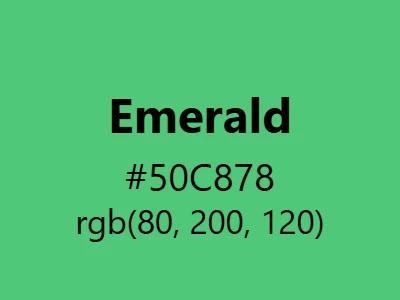
HEX
#50C878RGB
rgb(80,200,120)Shades of Emerald
Create custom shades of emerald with our color generator. Adjust hues, tints, and tones to find the perfect shade of emerald for your project.
Shades (Adding Black)
- 3B82F6rgb(59, 130, 246)
- 376BC8rgb(55, 107, 200)
- 31559Drgb(49, 85, 157)
- 294073rgb(41, 64, 115)
- 202C4Crgb(32, 44, 76)
- 151928rgb(21, 25, 40)
- 000000rgb(0, 0, 0)
Tints (Adding White)
- 3B82F6rgb(59, 130, 246)
- 6D95F8rgb(109, 149, 248)
- 91A9FArgb(145, 169, 250)
- AFBEFCrgb(175, 190, 252)
- CBD3FDrgb(203, 211, 253)
- E5E9FErgb(229, 233, 254)
- FFFFFFrgb(255, 255, 255)
Tones (Adding Gray)
- 3B82F6rgb(59, 130, 246)
- 5082E9rgb(80, 130, 233)
- 6182D7rgb(97, 130, 215)
- 6F83C4rgb(111, 131, 196)
- 7983B0rgb(121, 131, 176)
- 80849Brgb(128, 132, 155)
- 808080rgb(128, 128, 128)
Emerald Palette
Explore curated and automatically generated color palettes featuring emerald. See how it harmonizes with other colors for UI themes, graphics, and branding materials.
Sequential
Single hue gradient for data visualization
7 colors
Lightest
#DAF1FF
Light
#ACD2F3
Medium Light
#7AB5E7
Medium
#3498DB
Medium Dark
#2B6F9F
Dark
#214967
Darkest
#142634
Diverging
Dual hue gradient with a neutral midpoint
9 colors
Base End
#3498DB
Left Dark
#76AEE2
Left Medium
#A4C5E9
Left Light
#CEDDEF
Neutral
#F5F5F5
Right Light
#F5D5C3
Right Medium
#F1B593
Right Dark
#E89664
Complementary End
#DB7734
Monochromatic
Same hue, different brightness/saturation
5 colors
Lightest
#FFFFFF
Light
#A9CAED
Medium
#3498DB
Dark
#004D89
Darkest
#000000
Analogous
Colors adjacent on the color wheel (30° apart)
5 colors
Left Adjacent 2
#34DB77
Left Adjacent 1
#34DBCB
Main
#3498DB
Right Adjacent 1
#3445DB
Right Adjacent 2
#7734DB
Complementary
Colors opposite on the color wheel (180° apart)
2 colors
Main
#3498DB
Complementary
#DB7734
Triadic
Evenly spaced around the color wheel (120° apart)
3 colors
Main
#3498DB
Secondary
#DB3498
Tertiary
#98DB34
Square
Four colors evenly spaced (90° apart)
4 colors
Main
#3498DB
Right 90°
#CB34DB
Complementary
#DB7734
Left 90°
#45DB34
Tetradic
Two pairs of complementary colors
4 colors
Main
#3498DB
Secondary
#7734DB
Complementary
#DB7734
Complementary Secondary
#98DB34
Split Complementary
Complementary colors ±30°
3 colors
Main
#3498DB
Split Left
#DB3444
Split Right
#DBCB34
Cyclic
Circular gradient for periodic data
8 colors
0°
#3498DB
45°
#4D34DB
90°
#CB34DB
135°
#DB346E
180°
#DB7734
225°
#C2DB34
270°
#45DB34
315°
#34DBA1
Pastel
Soft, desaturated colors for modern UI
6 colors
Light Pastel
#A2B6C3
Pastel 1
#AFBFCB
Pastel 2
#BBC9D3
Pastel 3
#C7D3DB
Pastel 4
#D4DDE3
Deep Pastel
#E0E7EB
Common Green Color Codes (HEX & RGB)
Green →
HEX:#00FF00
RGB:rgb(0, 255, 0)
Dark Green →
HEX:#006400
RGB:rgb(0, 100, 0)
Light Green →
HEX:#90EE90
RGB:rgb(144, 238, 144)
Lime Green →
HEX:#00FF00
RGB:rgb(0, 255, 0)
Forest Green →
HEX:#228B22
RGB:rgb(34, 139, 34)
Sage Green →
HEX:#9CAF88
RGB:rgb(156, 175, 136)
Emerald →
HEX:#50C878
RGB:rgb(80, 200, 120)
Kelly Green →
HEX:#4CBB17
RGB:rgb(76, 187, 23)
Mint Green →
HEX:#98FF98
RGB:rgb(152, 255, 152)
Neon Green →
HEX:#39FF14
RGB:rgb(57, 255, 20)
Olive →
HEX:#808000
RGB:rgb(128, 128, 0)
Extract Emerald Hex & RGB Codes from Image
Upload a photo to find the exact emerald HEX and RGB codes.
click or drag your image here
Supported formats: JPG, PNG, WebP
Emerald Color Code Converter
Instantly convert between HEX, RGB, CMYK, and more for emerald shades.
All Formats:
- HEX:#ECB12E
- RGB:rgb(236, 177, 46)
- CMYK:cmyk(0%, 25%, 81%, 7%)
- HSV:hsv(41°, 81%, 93%)
- HSL:hsl(41°, 83%, 55%)
What is Emerald?
Emerald is a rich, vibrant green named after the precious gemstone of the same name. The word "emerald" comes from the Greek smaragdos, meaning "green gem," which in turn derives from the Sanskrit marakata, signifying "the green of growing things." For millennia, emeralds have been treasured by royalty and collectors alike. Ancient Egyptians adorned themselves with emerald jewelry as early as 330 BC, and Cleopatra was particularly fond of the stone, considering it a symbol of eternal youth.
Today, the finest emeralds come from Colombia's Muzo and Chivor mines, where the gemstones exhibit that characteristic deep, lush green with just the right amount of blue undertone. The color evokes images of dense tropical rainforests, spring foliage after rainfall, and the timeless elegance of antique jewelry.
The hex code for emerald is #50C878, with RGB values of rgb(80, 200, 120). This specific combination creates a color that is neither too yellow nor too blue—striking the perfect balance that gives emerald its luxurious, gemstone-like quality. Its CMYK values (approximately C:60, M:0, Y:40, K:22) emphasize cyan with minimal magenta and yellow, producing a rich, saturated green ideal for print applications.
Emerald occupies a special place in color theory as a medium-to-dark green with high saturation. It sits between teal and forest green on the color wheel, possessing the vibrancy of lime green while maintaining the depth of forest green. This unique positioning makes it incredibly versatile across design disciplines.
Emerald vs Similar Colors
Emerald sits among other luxurious greens:
| Color | HEX Code | Key Difference |
|---|---|---|
| Emerald | #50C878 | Rich, vibrant gemstone green |
| Forest Green | #228B22 | Darker, more natural |
| Jade | #00A86B | Deeper, more teal-leaning |
| Lime Green | #32CD32 | Brighter, more yellow-leaning |
Emerald is brighter than forest green but richer than lime green. It has more blue undertones than jade, giving it a cooler, more luxurious character.
Color Psychology and Meaning
Emerald carries significant symbolic weight across cultures and contexts:
Wealth and prosperity: As one of the most valuable gemstones, emerald has long been associated with luxury, abundance, and financial success. Ancient Incas believed emeralds were created when the sun's rays turned into stone, and they used them in religious ceremonies to invoke rain and agricultural bounty.
Growth and renewal: Emerald's lush green hue evokes spring foliage, new beginnings, and the cyclical nature of life. In many traditions, it represents rebirth and transformation, making it a popular choice for eco-conscious brands and wellness initiatives.
Love and romance: Emerald engagement rings have grown in popularity as an alternative to traditional diamonds. The color symbolizes deep, enduring love and commitment, with some cultures believing emeralds can strengthen relationships and promote harmony.
Healing and wellness: Psychologically, green is known for its calming effects, reducing eye strain and promoting relaxation. Emerald specifically has been linked to emotional healing, balance, and spiritual growth in various holistic practices.
Hope and optimism: During difficult times, emerald has served as a symbol of hope. Its vibrant green reminds us of nature's resilience and the promise of better days ahead.
Royalty and power: Throughout history, emeralds have adorned crowns, scepters, and royal regalia. Cleopatra, Charlemagne, and Catherine the Great all possessed extensive emerald collections, cementing its association with power and nobility.
Using Emerald in Design
Emerald's richness and versatility make it a favorite across design disciplines:
Web and UI Design: Emerald works beautifully for luxury brands, wellness platforms, and eco-friendly businesses. Its depth creates elegant interfaces, while its vibrancy makes CTAs stand out effectively. When designing with emerald, consider using it as a primary brand color for financial services, high-end spas, or sustainable fashion brands. Pair with gold or cream for sophisticated designs, or contrast with crisp white for a fresh, modern aesthetic.
Graphic Design: Emerald shines in premium packaging, wedding invitations, and high-end branding. It pairs beautifully with gold foil and deep burgundy for luxurious designs that feel both classic and contemporary. In editorial design, emerald can be used to draw attention to important headlines or create elegant divider elements.
Fashion and Interiors: A timeless choice for evening wear and accessories, emerald flatters a wide range of skin tones. In interiors, emerald adds drama as an accent wall, statement furniture piece, or rich upholstery. It works particularly well in rooms with natural light, where its depth and vibrancy can be fully appreciated.
Branding: Many iconic brands have incorporated emerald into their identities. The color conveys trust, luxury, and environmental consciousness—qualities highly valued in today's market. From high-end jewelry houses to sustainable startups, emerald communicates sophistication with a modern twist.
Digital Art and Illustration: Emerald's rich saturation makes it ideal for digital art, particularly for creating lush landscapes, magical forests, and fantasy elements. Its versatility allows it to serve as both a dominant color and a subtle accent.
Color Harmony and Combinations
Emerald's versatility extends to its ability to harmonize with a wide range of colors:
Monochromatic: Pair emerald with lighter mint greens and deeper forest greens to create depth and visual interest. This scheme works beautifully for eco-friendly brands and nature-inspired designs.
Complementary: Coral or salmon provides vibrant contrast, creating energetic and eye-catching combinations. This pairing is popular in fashion and graphic design for making bold statements.
Analogous: Teal, turquoise, and forest green create cohesive schemes that feel natural and calming. These combinations are ideal for wellness brands and spa environments.
Metallic accents: Gold, silver, and bronze elevate emerald to luxury. Gold in particular enhances emerald's richness, making it a favorite for high-end jewelry and premium packaging.
Neutral pairings: Cream, beige, and taupe provide elegant backdrops that allow emerald to shine without overwhelming the design. This combination is timeless and sophisticated.
Contrast with warm tones: For a bold, modern look, pair emerald with mustard yellow or burnt orange. This unexpected combination creates visual excitement while maintaining harmony.
For accessibility, emerald (#50C878) on white achieves approximately 4.5:1 contrast — meeting WCAG AA standards for normal text. When using emerald as text on white backgrounds, ensure proper font sizing for optimal readability.
Frequently Asked Questions
What is the emerald hex code?
The emerald hex code is #50C878. This rich green is widely used in design, jewelry, and branding for its luxurious and vibrant appearance.
What colors go well with emerald?
Emerald pairs beautifully with gold, cream, coral, burgundy, and navy. For modern designs, try combining it with mustard yellow or burnt orange for a bold contrast.
Is emerald the same as forest green?
No. Emerald (#50C878) is brighter and more vibrant than forest green (#228B22). Emerald has more blue undertones, giving it a cooler, more gemstone-like quality.
What are the RGB values for emerald?
The emerald RGB code is rgb(80, 200, 120). This combination creates a balanced green with strong green intensity and moderate blue, resulting in the characteristic lush appearance.
What is emerald's CMYK value?
Emerald CMYK is approximately C:60, M:0, Y:40, K:22. This formulation produces its characteristic rich green in print, emphasizing cyan to achieve that deep, saturated color.
Where does the name "emerald" come from?
The word "emerald" derives from the Greek smaragdos, meaning "green gem," which comes from the Sanskrit marakata, signifying "the green of growing things."
What makes emerald different from other greens?
Emerald's unique quality lies in its balance of vibrancy and depth. Unlike lime green (too bright) or forest green (too dark), emerald strikes the perfect middle ground, making it suitable for both bold and subtle designs.
Is emerald suitable for web design?
Yes, emerald is excellent for web design. Its hex code #50C878 provides good contrast on white backgrounds (approximately 4.5:1), meeting WCAG AA standards for accessibility.
What emotions does emerald evoke?
Emerald evokes feelings of luxury, growth, renewal, and hope. It's associated with wealth, healing, and emotional balance, making it a versatile choice for many design applications.